Unknown's avatar

Posts by Melissa Watts

Thanks for visiting my blog.

Place as Character – Toni Jordan Nine Days

art-353-Nine-Days-300x0-184x280 I’ve seen Toni Jordan speak at quite a few events, and I was fortunate enough to hear her again towards the end of last year at the Ballarat Mechanics Institute. It was just after the launch of her latest novel, Nine Days.

I knew about the general premise of the book before I bought it – that Jordan was inspired by a photograph from the Argus records. (The image is on the cover of the book) But what I didn’t know was that the nine days of the title, refers to the plot structure. The novel tells of nine days, spread across seventy years, which transform the lives of each member of the Westaway family.  Each chapter is narrated by a different member of the family as they face their transformative day. However the plot is not structured chronologically. This device is a wonderful tool for driving the plot. Readers are left to fill in some blanks when the novel jumps from 1939 to the weeks immediately after the September 11 collapse of the world trade centre in 2001. We wonder who the new narrator is and how is she related to Kip, the character we’ve just grown to love in chapter one. This continues through the book, and it’s Jordan’s skill as a storyteller that ensures that readers don’t feel dislocated, instead urging them on with a new character who is just as fascinating as the one before. Continue reading →

Writing Workshops

Ballarat Writers have launched their 2013 Workshops

Based on the success of previous years the writing workshops are back with a range of topics to inspire writers of all levels and genres.


This year’s workshop facilitator is local author and poet Karen Sparnon.

Karen has twenty-five years teaching experience and a PhD in Professional Writing and Editing. Her first novel, Madonna of the Eucalypts, was published by Text Publishing in 2006. It was translated and published overseas, and in 2007 won the Grollo Ruzzene Foundation Prize for Writing about ltalians in Australia. She has recently completed her second novel, which is again set between Italy and Australia, and is at work on her third novel.


Workshop topics include:

February 23rd Continuing the Mythic Journey, exploring the emotional arc.

March 23rd, Struck by Lightning, exploring how creativity works, and how to make it work for you.

April 20th, How to deal with your characters emotional lives, outlining how to add depth and create compelling characters.

June 15th, To plot or not to plot – that is the question, determining key structural conventions within fiction.

July 13th, Shaping life into life writing, for writers working on biography, autobiography and life writing.

August 10th Just when you thought it was finished, looking at what writers should focus on when drafting and re-drafting.


For the complete detail of each of these workshops, session times and locations visit www.ballaratwriters.com


A quick fling or a long-term relationship?

Over the past few months I’ve had some success with some short stories and poetry I’ve written. It’s been a really invigorating time for my writing and I can’t help but making the parallel between a quick fling and a long-term relationship.

For about 4 years I’ve been working on the same novel, slogging away, comfortable in its familiarity. It’s become cozy, dependable and we’ve both spread out around out middles like a couple who have been together for a while. Don’t get me wrong I love it, but these last few months feel like it’s been away on a business trip and I’ve just discovered a nightclub of swingers at the end of the street, (figuratively speaking of course).

Along came the novels and poetry and bam, I’ve remembered what it’s like to be in throws of a passionate stanza, or a quickie story, joyously experimental. It’s been exciting and successful and has got me wondering if I’m wasting my time with my long-term love?

I’m feeling a bit like the pilot with two families – can I balance both? Come home to roost with the novel but have the occasional weekend away with saucy story or a pumped-up poem? Should I give the novel an ultimatum perhaps? I do have a 6 month plan for the novel, I might just try my hardest with it and make up my mind then…

Art Monthly Magazine

If you are a reader of Art Monthly Magazine look out for my poem. It’s the poem I wrote for the Capturing Flora exhibition at the Ballarat Art Gallery, described by editor Maurice O’Riordan as:

Honing in on one historical and one contemporary rendition (both by women) of the same genus, Watts’s poem traces the changing aesthetic of botanical art with…a wonderfully charged and intricate sexual pulse.


artmonthly

Why I’m a bit smug this week

This is a big week for me.

On Saturday I was invited by the Art Gallery of Ballarat to be part of the ‘entertainment’ for their fantastic garden party. The garden party was part of the Capturing Flora exhibition and I was invited to read my poem inspired by the collection (more on that later). For pics and a review of the night see Amy Tsilemanis’s blog. Amy is the host of the Tinderbox radio program at Voice FM Ballarat.

Wednesday was a rehersal for the Artists Inspire Artistry recital and a quick trip in to visit Dave and Miles at Voice FM, Accessing the Arts program to discuss all things Ballarat Writers.

  Tonight I’ll be attending the launch of Eclectica, an anthology that I have 2 pieces published in. Then I’ll be dashing over to see Tor Roxborough at the Ballarat Writers reading night at the library. Eclectica is an anthology of work by University of Ballart students and Ballarat Writers members. I’ve seen the proofs and it looks great, it’s available in hardcopy or free e-book (although one of my pieces is missing from the e-book due to formatting difficulties).


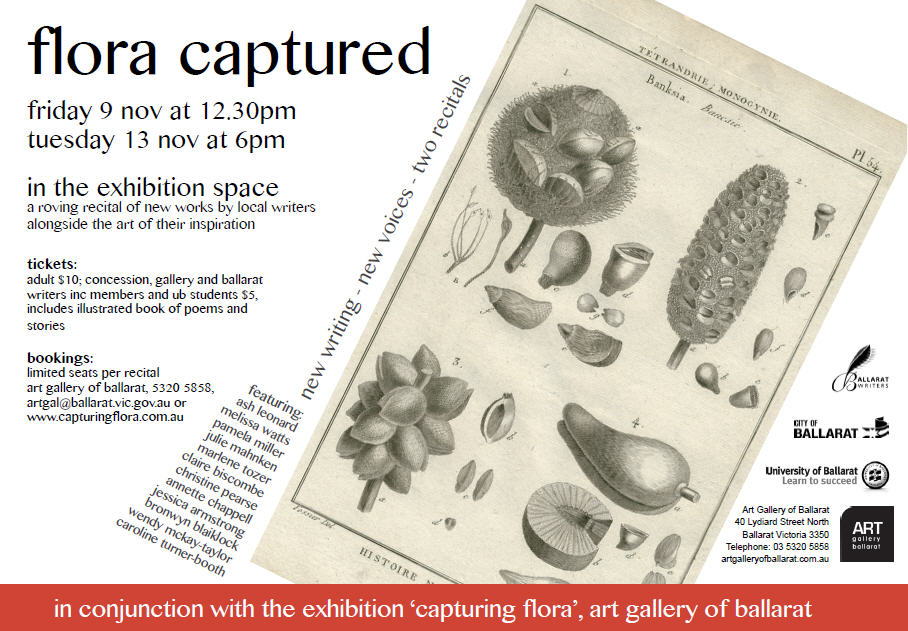
Friday is the big Artists Inspire Artistry recital (then again Tuesday). It is collaboration between the Art Gallery of Ballarat, the University of Ballarat and Ballarat Writers. A selection of aspiring writers have developed a range of poetry and vignettes inspired by the Capturing Flora exhibition, this style of writing is known as ‘ekphrastic’ writing. Annette Chappell from the University of Ballarat has mentored the writers as they develop their written work in response to an artwork from the exhibition.

The writers interpretations of the botanic art has been fascinating. A booklet containing the images with the new writing has been produced and will be available for purchase at the Gallery. Tickets are available to the Artists inspire Artistry event on Friday November 9 and Tuesday November 13, which includes a free copy of the book and a roving recital of the poetry. For details and tickets visit http://www.capturingflora.com.au/programs-and-events.aspx

If you’re in Ballarat I’d love to see you there!

The Mint Lawn – Gillian Mears

I have a confession to make.

It has taken me 5 months to read Gillian Mears’ The Mint Lawn.

In that time Mears has been shortlisted for the Miles Franklin and won the Prime Ministers Literary Award for Foal’s Bread.

And I was still plugging away with The Mint Lawn.

There are several plausible reasons for this. I have a 7 month old baby. I’m not getting a full night sleep. I’ve been busy with Ballarat Writers events….etc. etc.

But the honest reason is because of the book itself. It’s strong. It’s thought provoking. It requires energy and attention. It requires a slow read.

The Mint Lawn follows the life of Clementine Eastern nee Young. It’s not structured chronologically, so the novel begins with Clementine exposing her own affair to her husband and wondering if this is how it happened with her mother and father. From the opening page we understand that this will be a novel where familial bonds, and neuroses are examined. The examination is clinical, truthful as it looks at the legacy left by a dead mother to her three daughters, in relation to marriage, intimacy and sexuality.

The first 75 pages are told in the first person by a 25 year old Clementine, which firmly roots the reader with her, we are excited by the passion of her affair with the creative Thomas, we see the legacy of her childhood with her relationship with her adult sister and above all we see her characterisation of her husband. The first few paragraphs display Hugh crying over the exposed affair, “his crying is a high, unlikely whine…he is crying with his mouth stretched so wide I can see, against my will, years of coffee stains etched on the underside of his front teeth.” A paragraph on he licks her face while kissing her and Clementine informs us that, “later, the smell of Hugh’s dried spit is awful and ordinary Sunlight soap won’t do the job. I have to wash it away with the knob of Coal Tar that sits by the washing machine for extra persistent stains.” Hugh’s characterisation is complete by the bottom of page 2, and we will spend the rest of the 405 pages mentally urging Clementine to pack her bags and go.

Not all the novel is narrated in the first person present tense. We have sections of childhood told in third person, which allows us to examine the domestic scene closer, with our own adult perspective watching the three Young daughters interact with their mother, who we know will die, and we know already some of the character traits that her daughters will develop. This changing perspective and timeframe creates an ability for the reader to analyse the family in a way that wouldn’t be possible if the novel retained one perspective, or was chronological. And this is what requires the energy. The reader is placed almost as another daughter, watching the machinations of domesticity, aware of which traits will be picked up and continued through the daughters, and which will cause problems.

The Mint Lawn was Mears’ first novel and it won the 1990 Vogel award.  To consider the complexities of the book with its length (405 pages) it’s hard to believe that this was a first novel. I can see similarities with Christina Stead’s, The Man Who Loves Children, with the suffocating sense of the household replaced by the small town (a character itself) in The Mint Lawn.

 I felt that the novel is crafted brilliantly and reads like it has been created by someone who has published several novels before. With this in mind I did some research and discovered that sections of the book are biographical. In an interview in 2011 with Linda Morris for the Sydney Morning Herald, Morris notes that:

Mears, however, well understands the paradox of country life: the barefoot freedom and the claustrophobia of living in a conservative country town. At 18 she caused a scandal, falling in love with her history teacher. When they divorced, she rebelled in the sexual abandonment of carefree Paris.

Mears poured so much of her pre-divorce anger into The Mint Lawn that for a coming 20th-anniversary release, she edited out narrator Clementine’s more ”unsavoury observations”. Her past lovers, male and female, sexual trysts and life’s ”bad weather” are all matters about which she has been searingly honest.

Long ago, however, she reconciled with her former husband and family, with whom she fell out over looted memories. As she grows older, Mears has come to realise how deeply she can cherish ”certain aspects of even a marriage gone rotten”.
Read more: http://www.smh.com.au/entertainment/books/interview-gillian-mears-20111117-1njp5.html#ixzz2AMK7bQnY

The novel begins to make more sense to me when I realise that it has autobiographical elements to it – I’m glad I read it before I knew that, however it’s left me wondering if that’s where its power lies. Is it possible to create a novel that intense without an autobiographical element?

If you are interested in reading more on this there is a great article available online which was originally published by The Australian by Murray Waldren: http://users.tpg.com.au/waldrenm/mears.html

Gillian Mears, The Mint Lawn, Allen and Unwin, first published 1991.

This review forms part of the Australian Women Writers Challenge.

International Day of the Girl Child

Today is the first International Day of the Girl Child.

Some people will sigh “Another ‘Day of The…’ Do we need a day for everything? Is it just another day for feminists to carry on?”

Over the last few week’s I’ve really been thinking about the rights of women.

I’ve read great articles on the political debate regarding our Prime Minister (see this fantastic article by Anne Summers but choose the vanilla version or the R-Rated version).

I’ve witnessed in shock the treatment of Kate Ellis MP on Q and A this week (see this article by Ben Pobjie )

And of course we have all been made aware of the terrible crimes against women (including rape and murder) we see on our news. Several of us would have seen the negative comments and victim-blaming that has emerged as a result of this. (I’m not going to link to any of these, however Clementine Ford has written an article about it – warning it is distressing)

When people ask me my thoughts on women’s rights and why I identify as a feminist I reply that I feel it’s my obligation. It’s something I’m passionate about. Simply because I was born in Australia I have had fantastic opportunities for education in safe environments. Not everyone is that lucky and I feel that it’s an obligation of mine to speak out for those women and girls who don’t have the same rights. So what’s the difference between feminism and supporting basic human rights? For me it’s acknowledging that some crimes and discrimination occur purely because the victim is a girl or woman. (I don’t believe you need to be a woman to be a feminist either)

Unfortunately the term ‘feminism’ is so loaded that applying it to an argument is sometimes detrimental, depending on your audience.

So if you’d rather let’s remove the term feminism and just look at a few facts to show why we need this day:

We’ve known for years that the Taliban is against education for women. In fact ‘against’ isn’t really the word is it? What is the word for a group of people so intent on supressing the basic right of education for women that they will shoot a 14 year old girl in the head? The strength shown by Malala and her friends is incredible. I can’t compare it to anything in my life, and I’m sure neither can many other women who were raised in Australia. A day like International Day of the Girl Child reminds us that as children growing up in Australia we (or our sisters, or our partners, or our mothers) didn’t experience this, and our daughters won’t either.

According to the UN:

  • 1 in 3 women worldwide will experience physical violence at some point in their lives and 1 in 5 women are victims of sexual violence in their lifetime.
  • In Australia, violence against women was estimated to cost the economy $13.6 billion in 2008-9 and is estimated to reach more than $15 billion by 2020.
  • In South Africa, a woman is killed every six hours by an intimate partner.
  • Early marriage is a form of sexual violence which sees 60 million girls worldwide (31.1 million in South Asia) forced into marriage before the age of 18.
  • Female Genital Mutilation/Cutting is estimated to have been performed on between 130 and 140 million women and girls alive today.
  • In the Democratic Republic of Congo, an average of 36 women are raped every day.
  • In a national survey by the Australian Bureau of Statistics, 15% of Australian women said they had experienced violence by a previous partner and 2.1% by a current partner.

And I’ve posted before about the Because I’m a Girl program which highlights that a woman or girl will reinvest 90% of her income into her family. Taking care of girls helps everyone.

Prime Minister Julia Gillard opened today with this speech reminding us how lucky we are and the commitments being made by the Australian Government.

So call it what you like, gender equality, supporting human rights, feminism…but just don’t ignore that we do need the International day of the Girl Child.

Writing Projects

It’s taken me a while to write about some of the writing projects I’ve been working on but I’ve had some great chances to get some of my work published recently.

Earlier this year I wrote a short story to the theme of  ‘The Book as a Material Artefact’ for the journal Ex Parenthasis. 

I was lucky enough to have my story Tashkent’s Koran published along side work by E A Gleeson, Amy Tsilemanis, Jade Standing and Nathan Curnow.


In the next few months I will have a poem and short story published in the PWE Anthology from the University of Ballarat. More on that as it happens.


I’ve also just found out that I’ve been selected to participate in a fantastic writing initiative between Ballarat Writers Inc and the Art Gallery of Ballarat. Here’s a little about it:

The event is called ‘Artists Inspire Artistry: Reflections on Botanical Art’, and it is part of the Art Gallery’s ‘Capturing Flora’ exhibition, which opens on 25 September. The event aims to celebrate the beauty and rich diversity of Australian flora and its expression by botanical artists from the early explorers to the present day. It will present a collection of new poems and written works recited by their authors in front of the artwork of their inspiration as part of a ‘roving’ recital around the exhibition. We are scheduled to give not one, but TWO recitals of the new works – on 9 and 13 November.

So my novel is being neglected a bit, but I’m enjoying the new inspiration!