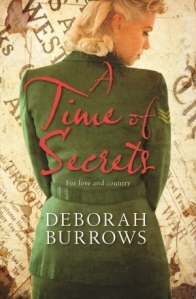
Deborah Burrows – A Time of Secrets


Old habits die hard.
I’m no longer the Publicity Office at Ballarat Writers but I still feel the need to remind everyone of the upcoming Southern Cross Literary Prize because it’s a great prize.
The competition is open for short stories to 3000 words, and has an open theme. This year’s judge is Tony Birch. The prize is $1,500 AUD plus there will be two highly commended stories.
Entry is $20 per story. The winning stories will be announced and read at an award presentation in Ballarat in November 2015. The full results and judge’s report will be published on this website in December 2015.
Are there any Scrivener users who read this blog? I’m after some advice.
I am up to draft 5 on my novel, making changes post manuscript assessment. I am wondering if it is too late to start using Scrivener? I need to work on characterisation, add extra scenes and get an overview of if the structure is working.
I’m keen to use Scrivener to draft my novel for my PhD which I will start soon, but thought I might also use it for the redrafting. My main concern is that I might take ages to import the novel, get to know the system etc, when my excel spreadsheet I currently use seems to work well enough…or does it? Will I be blown away by the functionality of Scrivener never to return to the dark side of excel again?
I’m interested in any opinions.
Thanks writers.
Last month a poem I wrote for the Nillumbik Shire Council ekphrastic poetry award was judged ‘highly commended’.
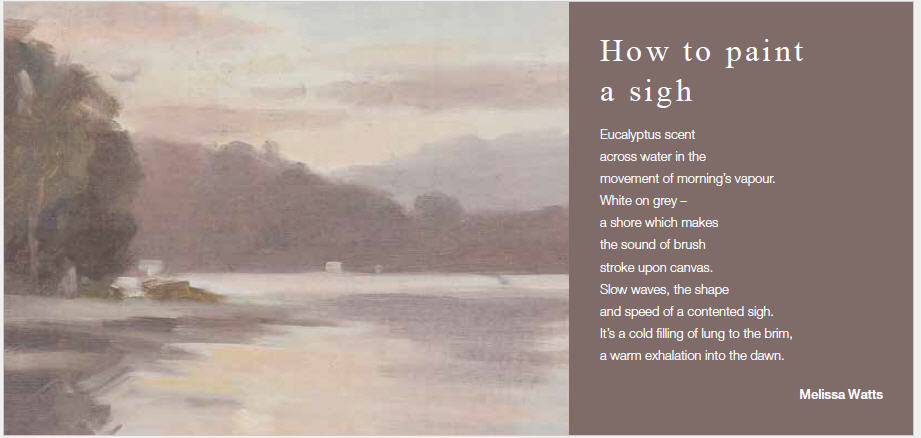
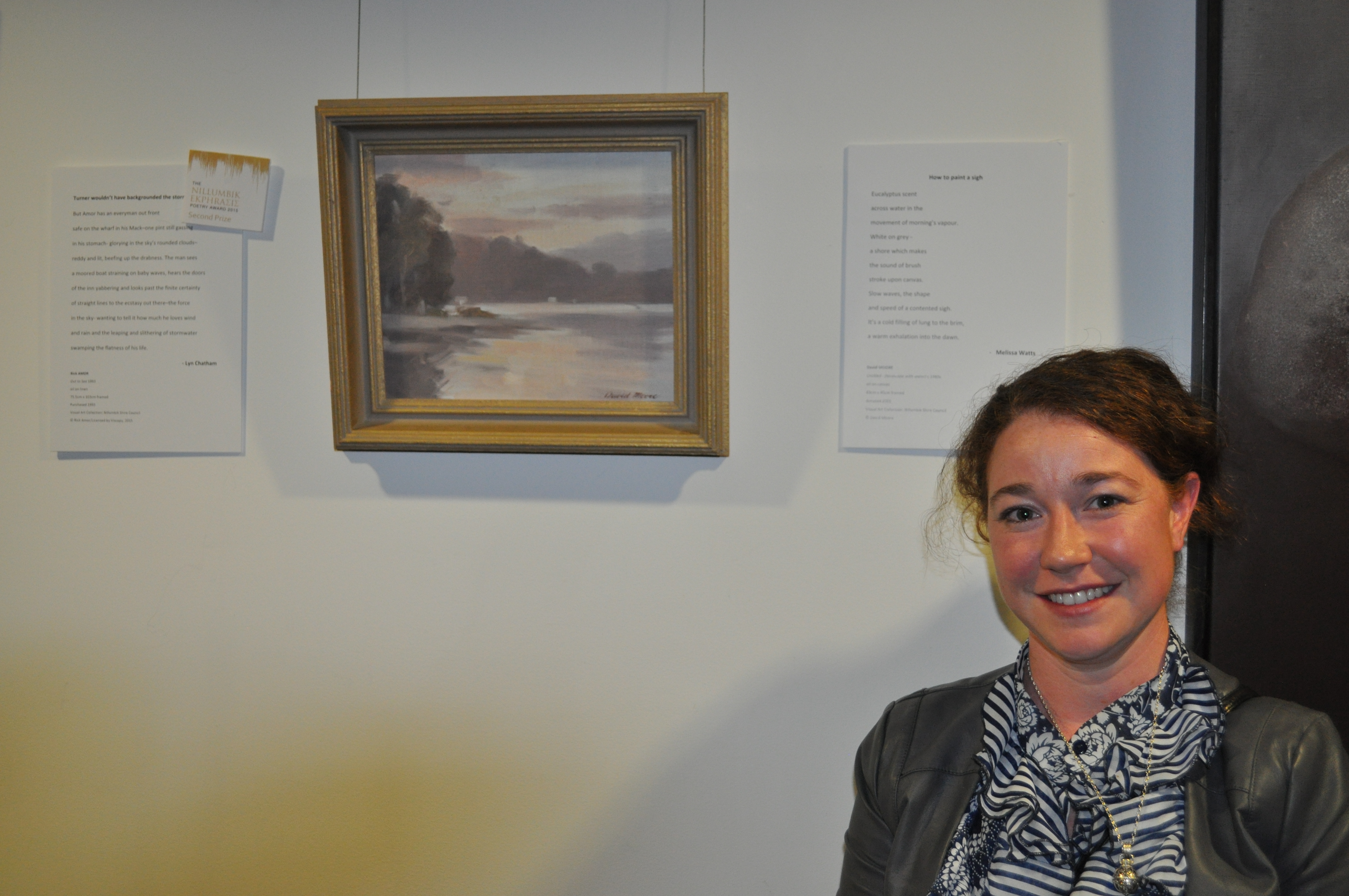
I wrote a poem, How to paint a sigh, in response to an untitled landscape by David Moore. All the winning and highly commended poems have been published onto postcards and can be found at various locations around the Nillumbik area. They are also available online with the judge’s report. I recommend that you read the judges report if you are thinking of entering next year, it’s a great resource. This year’s judges were Helen Lucas, Steve Smart and Karen Throssell. Their comments were:
I loved the title of this poem from the start – how does artist evoke a sigh? Both artist and poet create a wonderful serenity; the poet develops this by references to the senses, imagining the soft sound of the artist’s brush on canvas, the scent of the eucalypts. This work is an excellent example of an ekphrastic response.
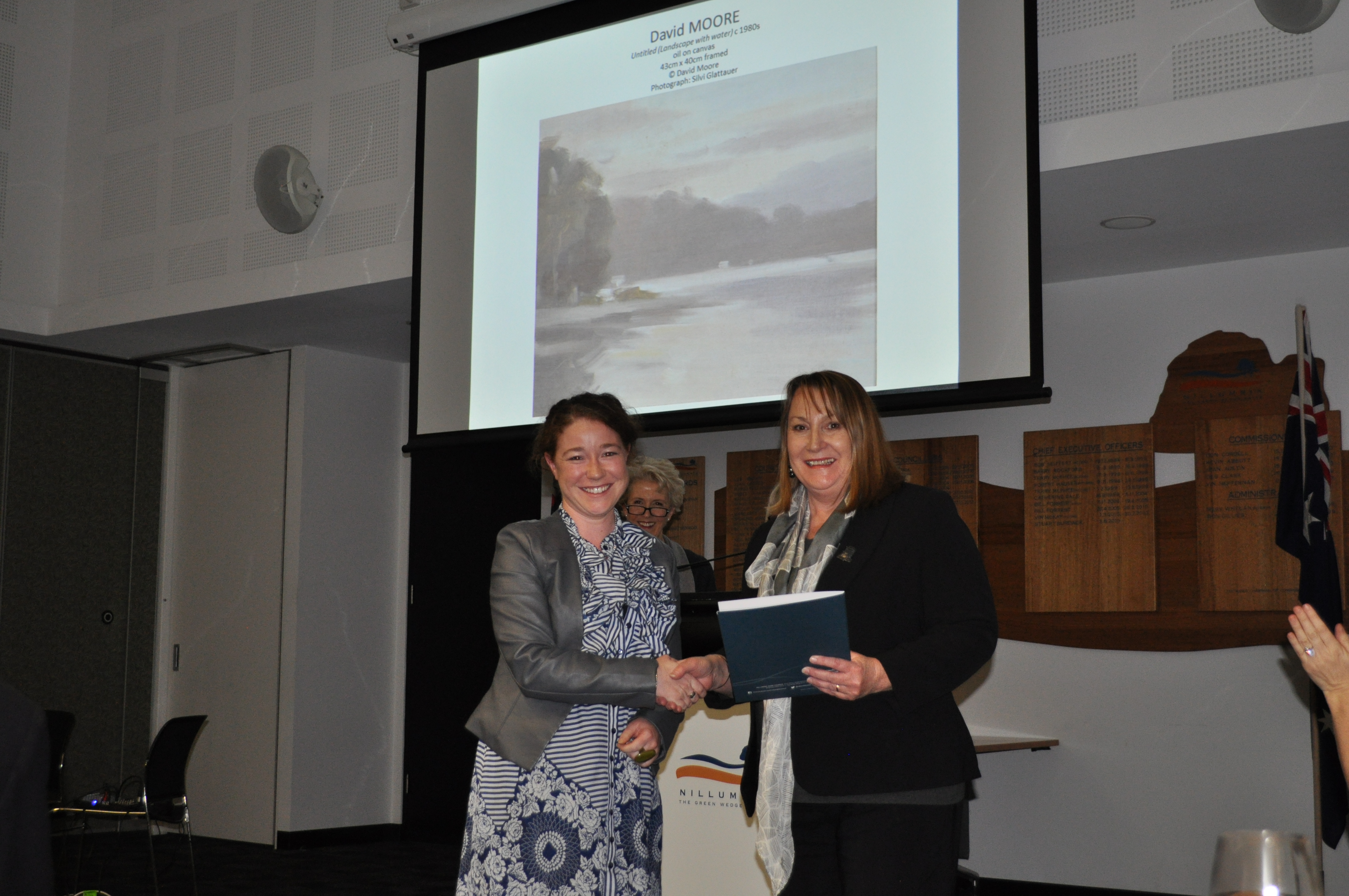
The awards evening was beautifully run. There was a small gallery of the work which was a great opportunity for some of the writers to see the art works for the first time (most of us viewed the works online). All of the poems were read by actress Debra Lawrance (Home and Away, Please Like Me) with images of the artwork projected behind. The awards were presented by Nillumbik Shire Council Mayor Cr Helen Coleman.
This was such a shock, and a great boost to my confidence, given that I have had a ten year gap in writing poetry and only took it back up for the Ballarat Writers ekphrastic poetry projects. (In fact when they first started I opened the opportunity to submit vignettes as well as I was too nervous to write poetry.)
The night was a bitter-sweet night for me, I kept thoughts of my fellow Ballarat Writers ekphrastic poet Pamela Miller close by. Pamela had passed away earlier that week, she was such a great writer and participant in all of the Ballarat Writers ekphrasis projects.
The competition is open each year to writers all over Australia so keep your eyes peeled for next year.

Nillumbik Ekphrasis Poetry Award Ceremony 2015: Melissa Watts (commended), Lyn Chatham (2nd Prize), Sandra Renew (commended), David Kelly (commended), Jo Wilson Ridley (commended), Helen Bradwell (3rd prize), Helen Lucas (judge), Mayor Cr Helen Coleman, Steve Smart (judge), Karen Throssell (judge), Debra Lawrance (special guest reader). Photo via Nillumbik Shire Council.
Twilight Talk, Art Gallery of Ballarat.
I’ll be talking tonight – Wednesday June 17, at 5.00pm (for a 5.30 start) at the Ballarat Art Gallery Twilight Talks.
I will be discussing women cartographers of WWII who were based at Villa Fortuna mansion in Bendigo. This is the topic of my PhD thesis. This is part of a larger series of talks at the gallery as part of their Australians at War exhibition.
Everyone is welcome.
Gold coin entry. Wine and cheese will be served.
On Genre expectations.
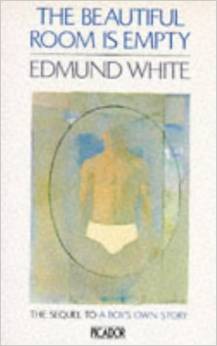
The Beautiful Room is Empty has sat on my bookshelf for years. I finally decided to read it when I was researching the genre of Künstlerroman. Künstlerroman means ‘artist’s novel’ in German and is closely related to the genre of bildungsroman, where a novel focuses on the growth of a protagonist usually through youth. In the case of künstlerroman the novel focuses on the development of the protagonist into an artist.
The Beautiful Room is Empty is a great novel that explores psychoanalysis and sexual repression within 1950s and 60s America. Themes of social class and gay experience predominate and the fact that the characters are artists seems to be secondary to that. I was hoping to learn about the development of the character as an artist, but the character arc was more about the protagonist’s changes in emotional and sexual maturity. I’m not entirely sure that it does meet the genre of kunstlerroman, given that most of the artistic successes outlined in the text are those of the unnamed protagonists friends, rather than the protagonist himself. I think the novel would be much better categorised as a bildungsroman.
So while it didn’t answer my question about the style of Künstlerroman it did teach me about fine writing. White has woven some really delicate expressions into many of the pages. He creates an image through personification and turning descriptive assumptions on their head. There is a strong sense of place and atmosphere with descriptions like, ‘a senile radio would be muttering to itself,’ (p3) and ‘I remember running with him down the street one grey winter afternoon when the sun, discouraged by a cold reception, had withdrawn.’ (p28) One of my favourites is ‘In Evanston I stood in the old bay window and looked out at Lake Michigan beating itself up.’ (p29) And ‘ On the floor a bum, reeking of sweet red wine, is sleeping it off, snoring loudly, a sound that draws a red line under the conspicuous silence.’ (p143)
There is also a wonderful sense of how the narrator sees the world:
‘The streets had been cleared, traffic lights lidded in snow burned like mad eyes, Christmas shoppers submitted to their forced labour, there were other cars cruising around as old and as dirty as ours, everyone seemed busy and indifferent – the rich anonymity of the city.’(12)
Then summer:
‘On this hot July night the streets were thronged with people. Here a crowd circled a sidewalk artist sketching a solemn young man with waved hair and spotty skin. The sitter was posing as though his profile were about to go on the coin of the realm. He was the only one who could not see how the sketch was coming along, this disappointment being patiently prepared for him.’ (133)
I love this last image of disappointment being patiently prepared, a larger metaphor life in some ways with tragic/comedic elements.
Edumund White The Beautiful Room is Empty, Picador 1988.
If you use the internet – in any capacity – read news online, tweet, comment on forums, you need to watch this.
Monica Lewinski gives a TED talk about the price of shame and it’s brilliant. I wanted to pull out standout quotes but there were so many that I couldn’t choose which one. But from now on I will think about public shaming as a bloodsport, it’s role in generating advertising dollars, and her brilliant quote of ‘ imagine walking a mile in someone else’s headline’.
Please take the 22 minutes to watch, it’s amazing.
Twilight Talk, Art Gallery of Ballarat.
Wednesday June 17, 5.00pm. Gold coin entry.
I will be discussing women cartographers of WWII who were based at Villa Fortuna mansion in Bendigo. This is the topic of my PhD thesis. Wine and cheese will be served. This is part of a larger series of talks at the gallery as part of their Australians at War exhibition.
Last month I hit two scary milestones – my baby turned 1 and started childcare, and my novel went out on its own for a manuscript assessment. The first day of childcare happened to coincide with me dropping my manuscript off so of course I began drawing obvious parallels, things like recognising that my novel has been with me for the last seven years, in my thoughts daily as I work on it, helping it grow so it can go off one day on its own, just like a child. It’s kept me awake at night, and some days I’ve felt like all I’ve done is wipe excrement off it.
Of course you can’t really compare a manuscript to a child but I was equally as nervous dropping off my baby to his carer’s as I was dropping my novel off to the assessors. But I think manuscript assessment is an important step for a few reasons:
Will I take on all of the feedback that Jill provides? Well…I guess only time will tell. Will I be drinking champagne or gin? Probably both.
Please let me know about your experiences of manuscript assessment and how it has worked well (or not) for you.