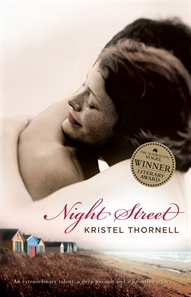
 Kristel Thornell’s Night Street is a fictitious imagining of the life of tonalist painter Clarice Beckett. Released this year after winning the 2009 Australian/Vogel award the novel is commonly viewed as being more biographical than fictional. Clarice Beckett was a young tonalist artist who studied under Frederick McCubbin then under Max Meldrum. Beckett’s works are now widely lauded and can be seen in collections in the National Gallery, various state galleries, and regional galleries such as Castlemaine and Ballarat. However Thornell is clear to point out in the Author’s note in the conclusion of the novel, “The Clarice who appears in this work is not Clarice Beckett (1887-1935) but my imagining of her. While the historical figure’s art and life inspired me, I took many creative liberties with these.”
I was eager to read this novel for a few reasons. I am a fan of Beckett’s work, after learning about the tonalist movement via the family history of my partner, who is related to Percy Leason, tonalist and political satirist. Another reason I was interested in reading this novel was because I am working on a novel where the protagonist is a female artist, albeit 70 years earlier, based in Melbourne. Continue reading →
 Melissa Watts